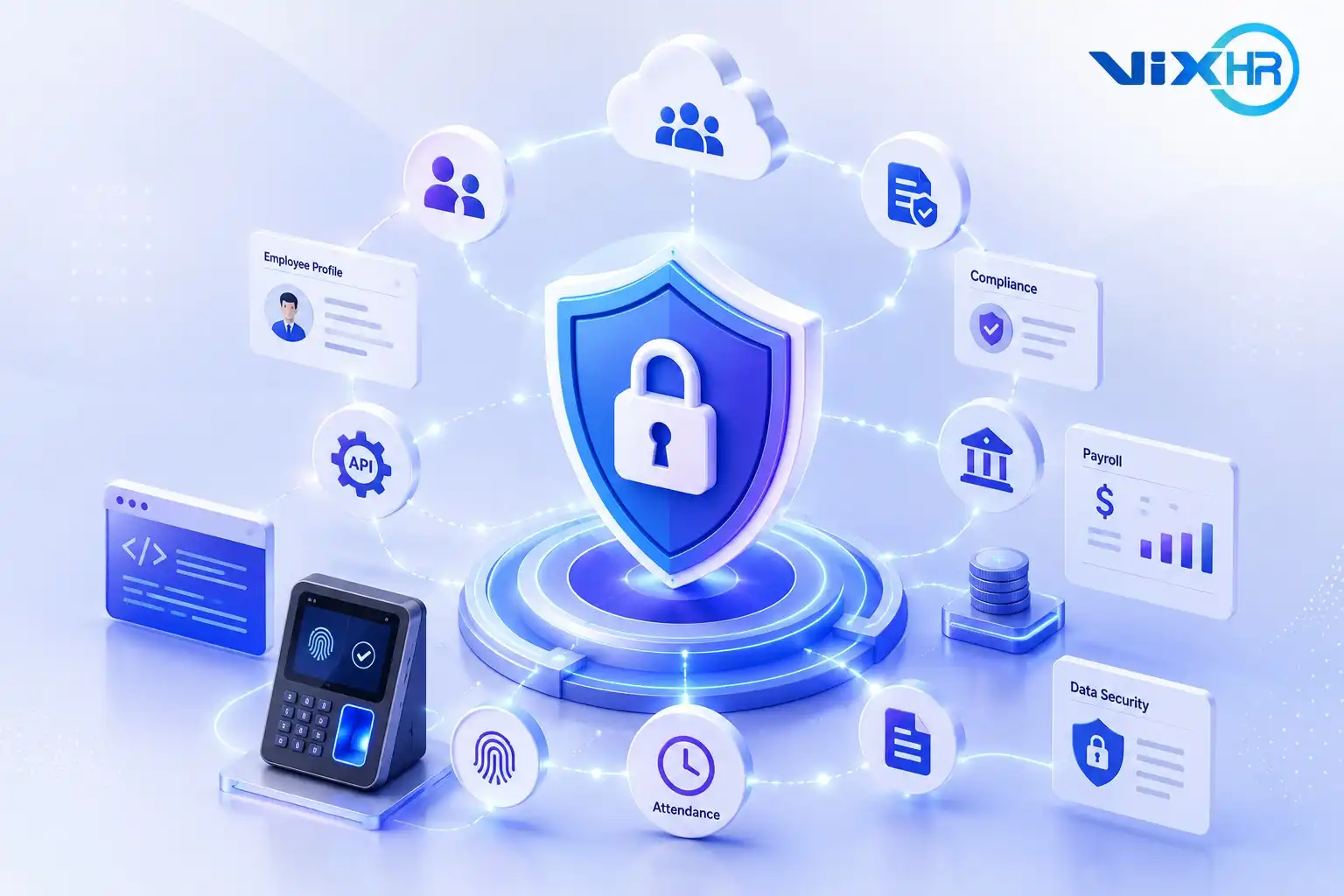
In today’s fast-moving business world, security and compliance aren’t afterthoughts, they’re foundational. For Sri Lankan SMEs and growing enterprises alike, deploying an HR platform that combines robust protection with seamless operations is essential. This article highlights the key features to look for and shows how you can build a resilient HR tech stack that scales, stays compliant, and keeps people productive.
1. A Unified HR Platform that Supports Real-Time HR Integrations
-Real-time HR Integrations: Your HR data moves at the speed of business. Real-time integrations ensure payroll, attendance, benefits, and performance data stay in sync across systems, reducing manual reconciliation and errors.
-RESTful API for HR: A well-documented RESTful API for HR enables secure, scalable connections between your HR software and other business tools. This is the backbone of a streamlined HR workflow automation strategy.
2. HR Workflow Automation and Process Automation
-HR workflow automation: Automating typical HR processes, onboarding, offboarding, leave requests, and performance reviews, reduces cycle times and human error while preserving compliance.
– HR process automation: A broader automation layer that coordinates tasks across HR, IT, and facilities, ensuring policy adherence and timely approvals.
– Self-service HR portals: Empower employees with self-service capabilities for time-off requests, document updates, and benefit elections, while maintaining data integrity and consistency across systems.
3. A Scalable and Integrated HR Platform
– Sri Lankan SMEs deserve a scalable HR software solution that grows with them. Choose an all-in-one HR software like VixHR or an integrated HR platform that can handle increasing employee counts, regulatory changes, and expanding data volumes.
– HR tech stack: A modern HR tech stack should blend core HRMS, payroll, time and attendance, recruitment, and learning management with integrations to accounting, ERP, and security tooling.
– Integrated HR platform vs. standalone modules: An integrated platform reduces data silos and simplifies governance, which is crucial for maintaining GDPR compliance and other privacy mandates.
4. Security, Access Control, and Compliance By Design
– Role-based Access Control (RBAC): Define roles (HR admin, manager, employee) with the least-privilege access to data and actions. Regularly review permissions to prevent insider risk.
– SSO Integration: Single sign-on reduces credential fatigue and improves access security by enabling centralized authentication across tools. Combine SSO with MFA for stronger protection.
– GDPR compliance: Even if you’re not in the EU, GDPR-style data handling principles help protect personal data. Ensure data minimization, purpose limitation, retention schedules, and secure data flows across the HR tech ecosystem.
– Bank Integrations and biometric device integration: If you handle vendor payments or biometric attendance, ensure these integrations are secure, auditable, and compliant with local data protection standards.
5. Data Protection and Identity Infrastructure
– Facial recognition devices: If you deploy biometric devices for attendance, ensure the solution stores biometric templates securely, uses local processing when possible, and supports opt-out policies and data retention controls.
– SSO Integration and API security: Use OAuth 2.0, JWTs, and encrypted channels (TLS) for all API calls. Regularly rotate keys and monitor for anomalous access.
– API documentation and governance: Maintain a formal API documentation repository and an API governance process to manage changes, deprecations, and security patches.
– Custom HR integrations: For Sri Lankan SMEs with unique needs, consider customizable integrations for legacy systems while maintaining security standards.
6. Real-World Value: Sri Lanka and SMEs
– Sri Lankan SMEs benefit from a HR platform that combines real-time insights with predictable cost structures and local support. A cloud-based, scalable HR platform with strong security helps SMEs compete with larger enterprises without sacrificing compliance.
– Benefits of HR automation for SMEs: Faster onboarding, accurate payroll, improved data quality, better compliance posture, and a more engaging employee experience.
7. Implementation Considerations: API-first, Secure, and Compliant
– HR API integration guide and RESTful API for HR: Start with an API-first mindset. Design APIs with versioning, pagination, and granular permissions to support scalable growth.
– Real-time API integration and self-service portals: Real-time data feeds enable accurate analytics and timely approvals. Self-service portals reduce manual queries and empower employees to manage their data responsibly.
– Bank Integrations and payroll data security: Payroll data is highly sensitive. Use encrypted data transfer, strict access controls, and audit trails for any financial interface.
Conclusion
Protecting your data and systems while enabling efficient HR operations is not a trade-off—it’s a design choice. By prioritizing an integrated HR platform like VixHr, with real-time HR integrations, robust RBAC, SSO, GDPR-conscious data handling, and scalable APIs, you can build a secure, compliant, and agile HR tech ecosystem. For Sri Lankan SMEs and larger enterprises alike, the right combination of HR workflow automation, self-service capabilities, and secure custom integrations will unlock the benefits of automation while safeguarding people and data.
If you’re starting your journey with VixHR consider that it’s an all-in-one HR software with strong API documentation and governance. It’s the foundation for scalable, secure, and compliant HR that supports growth today and tomorrow.